
Payout and Payin APIs for Indian Businesses: A Practical Guide
2All Super Admin · · 4 min read
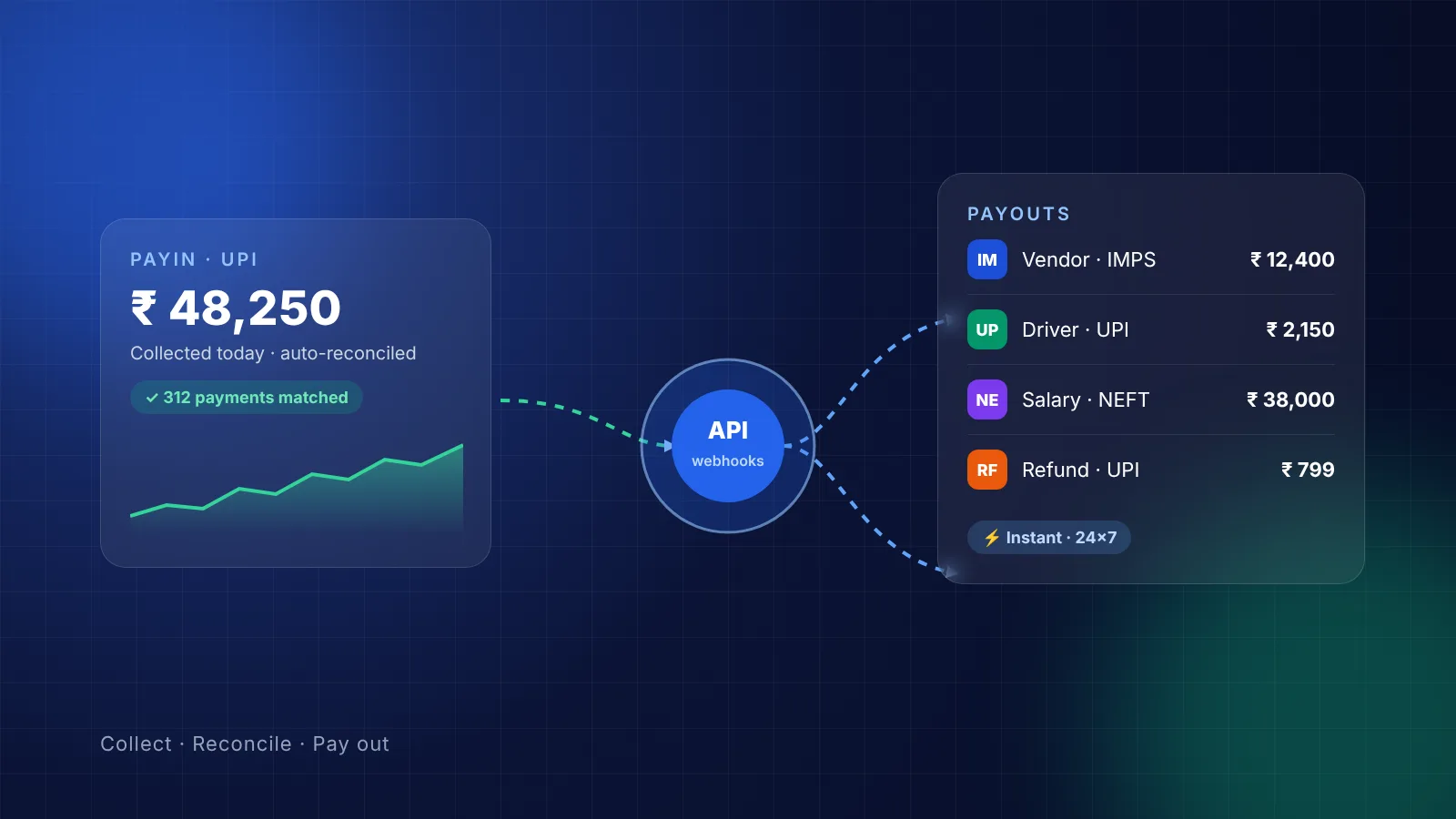
Collecting money from customers and paying it out to vendors, staff or partners are two of the most repetitive jobs in any growing business. Done by hand — downloading bank statements, matching UTRs in Excel, uploading bulk payment files — they eat hours every week and leave room for costly mistakes.
Payin and payout APIs automate both sides. This guide explains how they work, where they fit, and what to look for before you choose a provider.
What is a payin API?
A payin API lets your website, app or billing system collect money from customers without manual follow-up. Common payin methods in India include:
- UPI — collect requests, dynamic QR codes and intent links that open the customer's UPI app
- Virtual accounts — a unique account number per customer, so incoming bank transfers are matched automatically
- Payment links — shareable links sent over SMS, WhatsApp or email
- Cards and net banking — through a payment gateway checkout
The key benefit is automatic reconciliation. Each payment comes back to your system with a reference, amount and status via webhook, so invoices are marked paid without anyone checking the bank statement.
What is a payout API?
A payout API lets you send money from your business account to many beneficiaries programmatically. Typical rails are:
| Rail | Best for | Speed |
|---|---|---|
| IMPS | Instant transfers to bank accounts | Real time, 24×7 |
| UPI | Small payouts to a UPI ID | Real time, 24×7 |
| NEFT | Regular vendor and salary payments | Settled in batches |
| RTGS | High-value transfers | Real time, for large amounts |
Instead of preparing a bulk file and uploading it to net banking, your system calls the API, gets a transaction ID and receives the final status (success, failed or pending) through a webhook.
Where businesses use them
- Marketplaces and aggregators — collect from buyers, settle to sellers after deducting commission
- Taxi and delivery platforms — daily or weekly driver payouts
- Lending and insurance — loan disbursals, claim settlements and EMI collection
- Retail and distribution networks — retailer wallet top-ups and commission payouts
- Payroll and gig work — salaries, incentives and reimbursements
- Refunds — instant refunds to the customer's original account or UPI ID
Benefits over manual processing
- Speed — instant IMPS and UPI payouts instead of waiting for someone to log in and approve a batch
- Fewer errors — account validation before transfer and no copy-paste of account numbers
- Real-time status — webhooks tell your system exactly which payments succeeded or failed
- Easy reconciliation — every transaction carries your own reference ID and the bank UTR
- Scales with volume — 10 or 10,000 payouts a day use the same integration
What to check before choosing a provider
Compliance and partner banks. Make sure the provider works with RBI-regulated banks or licensed payment entities and follows KYC requirements for your business and, where needed, for your beneficiaries.
Beneficiary verification. Penny-drop or name-match verification confirms the account holder's name before you send money, which prevents payouts to the wrong account.
Webhooks and status APIs. Pending transactions happen. You need reliable callbacks plus a status-check API to resolve them without raising support tickets.
Dashboard and reports. Your finance team should be able to search transactions, download statements and see balances without touching the API.
Security. Look for IP whitelisting, signed requests, role-based access and two-factor authentication on the dashboard.
Transparent pricing. Understand per-transaction charges for each rail, any setup fees, and GST on charges, so there are no surprises on your monthly invoice.
Support. Payment issues are time-sensitive. Check response times and whether you get a dedicated contact during integration.
How integration usually works
- Complete business onboarding and KYC
- Get sandbox credentials and test payin and payout flows
- Whitelist your server IPs and set up webhook URLs
- Go live with a small volume, then scale
- Fund your payout account and monitor balances from the dashboard
Most teams can finish a basic integration in a few days using REST APIs and the provider's sample code.
Getting started with Pay2All
Our Payout and Payin solution gives you UPI collections, virtual accounts and instant bank payouts through one dashboard and one API, with webhooks, beneficiary verification and downloadable reports built in. If you also run a retail or agent network, it pairs well with our Recharge Software.
Want to see it working with your use case? Request a demo and our team will walk you through the sandbox.